Highlights
Entry to Al Masmak Fortress / Palace Museum, giving access to the main courtyard, interior rooms, towers and small mosque, all restored with traditional mud-brick finishes and wooden ceilings.
About this experience
Al Masmak Fortress — also known as Al Masmak Palace — is a 19th-century clay and mud-brick fort in Riyadh’s old ad-Dirah district, a classic piece of Najdi architecture with thick defensive walls and corner towers. Built in the late 1800s and famously stormed by Abdulaziz Ibn Saud in the 1902 Battle of Riyadh, it now serves as a museum telling the story of the unification of Saudi Arabia.
What's included
- Entry to Al Masmak Fortress / Palace Museum, giving access to the main courtyard, interior rooms, towers and small mosque, all restored with traditional mud-brick finishes and wooden ceilings.
- Museum exhibits on the unification of Saudi Arabia, including historical photographs, maps, weapons, clothing, models and dioramas illustrating the 1902 recapture of Riyadh and the early Saudi state.
- Informational panels (mainly Arabic with some English) and short films that explain how the battle unfolded and why the fort is central to Saudi national history.
- Access to the surrounding pedestrian square and heritage streets of old Riyadh, where you can see the fort’s exterior, nearby souqs and views towards Al-Hukm Palace.
- NOT included: guided tours (unless you book one), hotel transport, food and drinks, parking fees around Dirah, or any experiences at other King Abdulaziz Historical Center sites.
Who it's for
- Ideal if you want a compact, very “Saudi history 101” stop in central Riyadh — unification, Ibn Saud and traditional Najdi fort design all in one place.
- Great for first-time visitors, history lovers, families and anyone doing a half-day “old Riyadh” loop with nearby souqs and squares.
- Works for most fitness levels: the main courtyard and galleries are on ground level; tower/roof access involves stairs and may not suit everyone.
- Generally accessible around the courtyard and some indoor areas, though fully step-free coverage to upper levels is limited in a historic mud-brick structure.
What you'll do
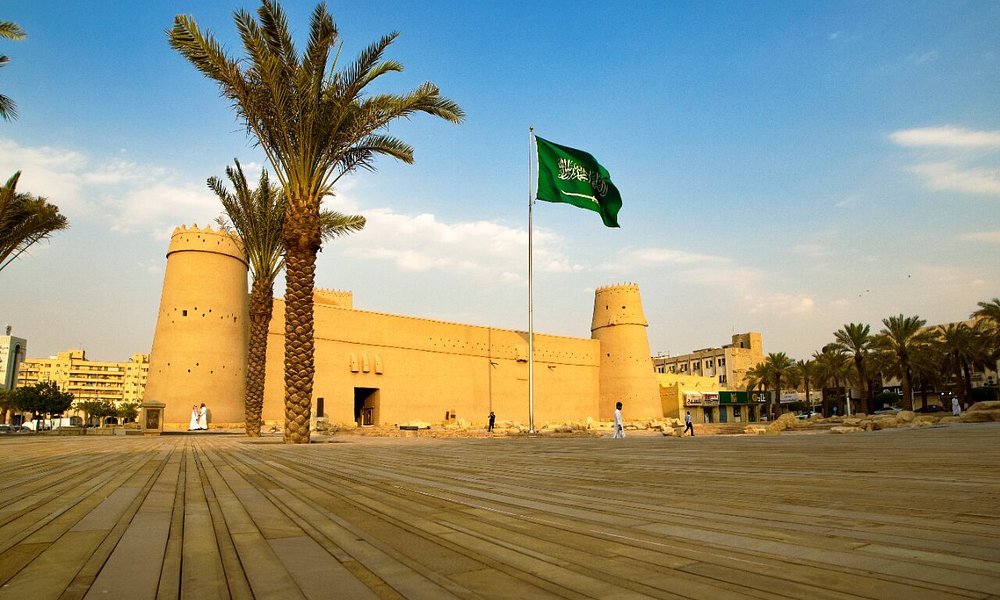
- Arrive in the old Dirah area by taxi, rideshare or tour bus and walk across the open square to the sand-coloured fortress with its round corner towers.
- Enter through the heavy wooden gate with its famous narrow doorway, then step into the central courtyard surrounded by arcades and small rooms.
- Move through the museum rooms to see weapons, clothing, photos and maps, plus models of Riyadh and explanations of how Abdulaziz Ibn Saud’s small force scaled the walls and retook the fort in January 1902.
- Climb (if open and you are able) up inner stairs to one of the towers or upper walkways for a closer look at the mud-brick construction and views over the historic district.
- Finish with a walk around the exterior for photos and then head into nearby souqs and cafes, or continue on to other King Abdulaziz Historical Center sites.
Before you go
- Tickets / price (starts from): several up-to-date tourism sources state that entry is currently free, though some traveller reports mention around 10 SAR charged at times. For planning, treat 0—10 SAR as a realistic range and be prepared for small changes.
- Opening hours: recent guides and official-info summaries describe hours of roughly 08:00—21:00 on most days, with shorter hours on Fridays (typically opening mid-afternoon) and slightly varied Saturday timings. Always check the latest times locally or via Visit Saudi before you go, especially in Ramadan and on public holidays.
- Dress code: there’s no special requirement beyond normal Saudi public-space norms — modest clothing that covers shoulders and knees (abayas and hijab for women in line with local practice) and comfortable shoes for walking on stone floors and stairs.
- Behaviour: this is a national-heritage museum — keep voices low, don’t climb on walls or cannons, and follow museum staff instructions. Tripods and commercial filming may require prior permission.
- Climate: the fort is partly air-conditioned but still feels like a traditional adobe structure; in summer, plan your visit for morning or evening and drink water regularly.
Good to know
- Location: Al Masmak Fortress stands in Dirah (Qasr al-Hukm district) in central Riyadh, close to Al-Hukm Palace and traditional markets, roughly 15—20 minutes’ drive from newer areas like Olaya and Kingdom Centre.
- History snapshot: commissioned in 1865 and completed in 1895, the fort became the stage for Abdulaziz Ibn Saud’s surprise raid on 13—15 January 1902, which kicked off the campaigns that unified the kingdom by 1932.
- Architecture: classic Najdi defensive style with thick clay-and-mud-brick walls, four corner towers, an interior mosque, central courtyard and traditional palm-trunk and sarooj construction details.
- Time needed: most visitors spend 1—2 hours here, enough to see the museum rooms, climb a tower and take photos in the courtyard and surrounding square.
- Combo ideas: easy to pair with nearby Souq Al Zal / Al-Zal Market, other Dirah heritage streets and evening coffee or dinner in central Riyadh.
Why this is worth it
Budget about 0—10 SAR and 1—2 hours for Al Masmak Fortress — a restored 19th-century clay and mud-brick fort in old Riyadh where Ibn Saud’s 1902 recapture of the city began the unification of Saudi Arabia, now a small but dense museum of weapons, photos and exhibits wrapped inside classic Najdi fortress architecture.