Highlights
A timed, guided visit to Hegra with transfers from the AlUla visitor hub by coach or similar vehicle; self-driving inside the site is not allowed.
About this experience
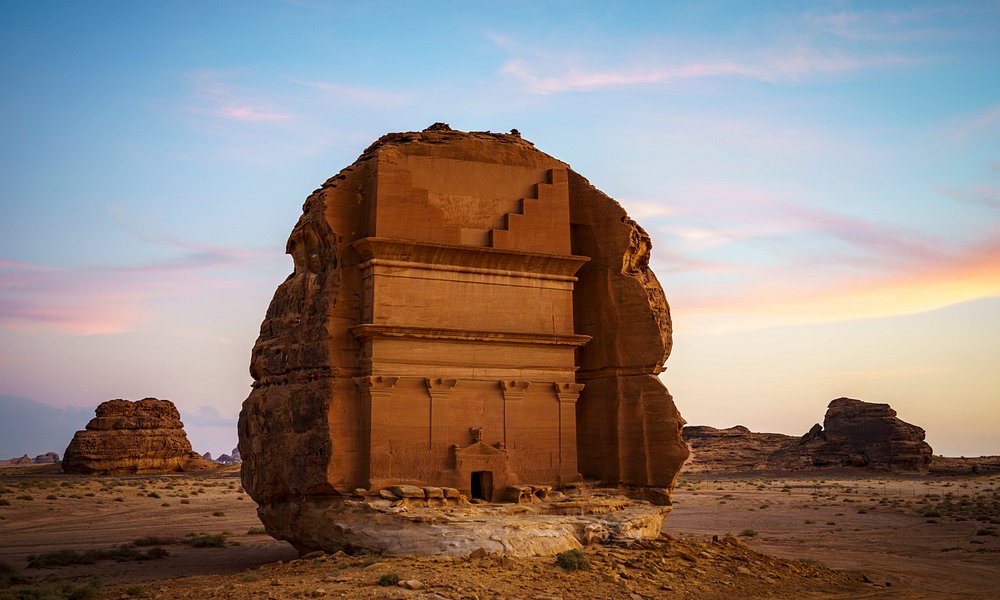
Hegra, also known as Madain Salih or Al-Hijr, is Saudi Arabia's first UNESCO World Heritage Site and the largest preserved Nabataean city south of Petra. Set in the desert near AlUla in north-west Saudi Arabia, it has more than 100 monumental rock-cut tombs carved into sandstone outcrops between the 1st century BCE and 1st century CE, along with pre-Nabataean inscriptions and remnants of the old Hijaz Railway that once connected Damascus with Madinah.
What's included
- A timed, guided visit to Hegra with transfers from the AlUla visitor hub by coach or similar vehicle; self-driving inside the site is not allowed.
- Access to the core archaeological zone, including several of the main necropolis areas and signature tombs such as Qasr al-Farid (the largest free-standing tomb), Jabal al-Banat and other carved rock faces.
- Expert commentary from licensed guides in Arabic and English, explaining Nabataean history, tomb inscriptions, trade routes and how Hegra linked to Petra and the incense road.
- Multiple stops where you can get off the bus, walk short distances on marked paths, look closely at tomb facades, read information panels and take photos from approved viewpoints.
- Basic services such as shaded waiting areas, toilets and water at or near the visitor facilities (not at every tomb stop).
- NOT included: transport from your hotel to the AlUla visitor centre, meals, souvenir purchases, private photography sessions, premium experiences (such as vintage Land Rover tours, AR headsets or hop-on hop-off upgrades) unless booked as a specific package.
Who it's for
- Ideal for travellers interested in archaeology, history and desert landscapes who want a less crowded alternative or complement to Petra.
- Suitable for most reasonably mobile visitors, including families with school-age children, as long as everyone is comfortable with walking on sand, gravel and uneven ground in sun and heat.
- Works for photography lovers who want dramatic rock formations, tomb facades and wide desert vistas, especially at softer light times in the morning or late afternoon.
- Less suitable for visitors with serious mobility issues who cannot climb steps or walk short distances; although the tour uses vehicles between stops, access to viewpoints still involves some walking on uneven terrain.
What you'll do
- Travel from AlUla town to the designated visitor hub or Winter Park, check in for your booked Hegra tour and meet your guide and group.
- Board a dedicated shuttle or coach for the 15—20 minute drive out through the desert landscape to the Hegra site, listening to an introduction about Nabataean history and UNESCO status along the way.
- Visit a series of stops chosen by your guide — typically including major tomb clusters where you can stand beneath towering facades, see carved inscriptions and motifs, and learn how status, families and professions were recorded in stone.
- Spend time at Qasr al-Farid, the famous lone tomb carved into a freestanding rock outcrop, to appreciate its scale and the incomplete lower section that shows how the carving process worked from top to bottom.
- Depending on your tour type, experience extra elements such as an augmented reality “living museum” layer, children's storytelling focus, or more time exploring additional tomb groups and viewpoints.
- Return by coach to the visitor hub, where you can browse small exhibits, visit the café or gift shop and plan other AlUla experiences such as Dadan, Jabal Ikmah or adventure activities.
Before you go
- Tickets / price (starts from): official Hegra tours currently start from about 95 SAR per person for standard guided visits, with some special or hop-on hop-off experiences priced higher (for example, around 150 SAR and above). Treat 95 SAR as a realistic starting price for a basic adult ticket, and expect more for premium formats or bundles.
- Booking: advance online booking via the AlUla destination website is strongly recommended, especially from October to April when weather is cooler and demand is highest. Walk-ins may find limited availability or specific time slots only.
- Tour format: access is only by organised tour operated under the Royal Commission for AlUla; private cars are not allowed to drive around the tombs on their own. Visitors must stay with their group and follow guide instructions at each stop.
- Weather & clothing: Hegra is fully outdoors and can be hot, sunny and dusty. Wear modest, loose clothing that covers shoulders and knees, comfortable closed shoes, a hat and sunscreen; bring water and consider a light layer for cooler winter mornings and evenings.
- Site protection: climbing on rock faces or tomb facades, touching carved details, entering closed-off tombs and leaving litter are all strictly prohibited. Drones and professional filming usually require special permits in advance.
Good to know
- Location: Hegra lies in the AlUla region of north-west Saudi Arabia, roughly 20—25 km north of AlUla town and around 400 km north of Madinah, in a desert basin ringed by cliffs and rock towers.
- Heritage status: it became Saudi Arabia's first UNESCO World Heritage Site in 2008, recognised as the Nabataean kingdom's southernmost and second-largest city after Petra, with more than 100 monumental tombs and multiple necropolis zones.
- Time needed: most guided Hegra tours last around 2—3 hours including transfers inside the site; you will typically spend a good part of that time outside the vehicle at different stops.
- Best season & timing: the most comfortable months are generally October to April, with early morning and late afternoon tours offering kinder temperatures and more flattering light for photography.
- Pairing with other sites: Hegra combines naturally with other AlUla highlights such as Dadan, Jabal Ikmah (the so-called open-air library of rock inscriptions), Old Town AlUla and adventure or art experiences scattered across the wider landscape.
Why this is worth it
Budget from about 95 SAR per person and set aside 2—3 hours for Hegra — a guided, no-self-drive visit to Saudi Arabia's first UNESCO World Heritage Site near AlUla, where you ride a shuttle through the desert to walk among more than 100 Nabataean rock-cut tombs carved into sandstone cliffs between the 1st century BCE and 1st century CE.