Highlights
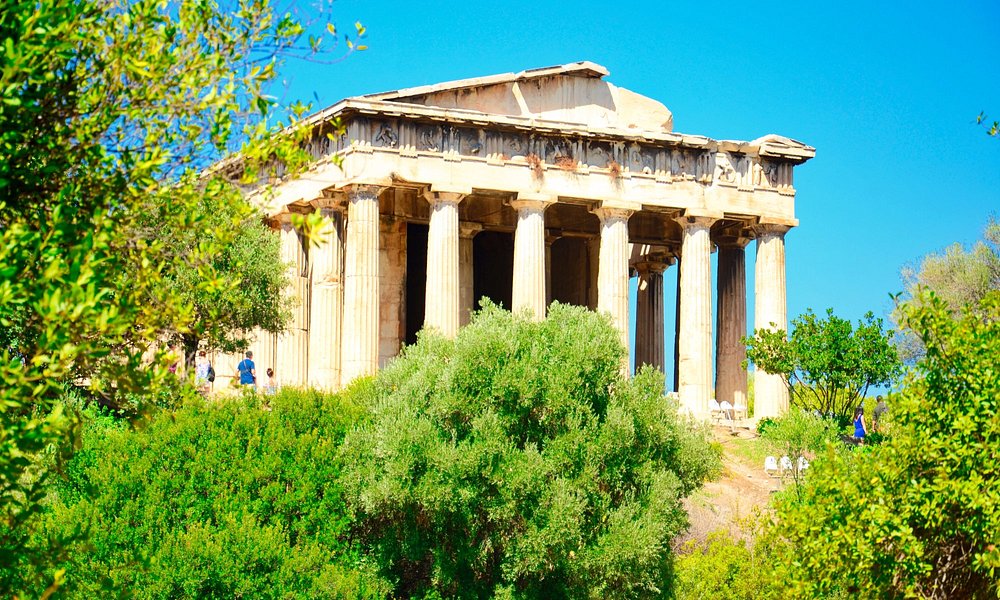
Standard ticket to the archaeological site and museum of the Ancient Agora, including access to key remains such as the Temple of Hephaestus, the Stoa of Attalos (museum), Bouleuterion area and other excavated ruins.
About this experience
Northwest of the Acropolis, the Ancient Agora of Athens is the old civic heart of the city — a low, green archaeological park where temples, stoas and public buildings once hosted Athenian democracy, markets and daily life.
What's included
- Standard ticket to the archaeological site and museum of the Ancient Agora, including access to key remains such as the Temple of Hephaestus, the Stoa of Attalos (museum), Bouleuterion area and other excavated ruins.
- Freedom to walk signed paths through the site, explore the reconstructed Stoa of Attalos with its museum displays and view the Agora from different vantage points.
- Basic on-site facilities like information boards, toilets and shaded areas near the stoa and some trees.
- NOT included: guided tours, audio guides, food and drinks or any combined Acropolis ticket you may buy separately.
Who it's for
- Ideal for history and archaeology fans, photographers and anyone who wants to understand how ancient Athenians actually lived and met below the Acropolis.
- Suits most reasonably mobile visitors: paths are mostly dirt and gravel with some steps and uneven stones.
- Less ideal for people who only want “one big monument” — this is a spread-out park of ruins plus one very well-preserved temple and a reconstructed stoa.
What you'll do
- Enter via the main gate near Monastiraki/Thissio, buy or scan your ticket and follow the paths into the site.
- Walk up to the Temple of Hephaestus on the low hill for one of the best-preserved classical temples in Greece and big views across the Agora and up to the Acropolis.
- Explore other ruins such as stoas, altars and civic buildings along the main paths, using the information boards to orient what each structure once was.
- Visit the museum inside the Stoa of Attalos to see statues, everyday objects, inscriptions and exhibits explaining how the Agora functioned as a civic and commercial centre.
- Finish with a slow loop back towards the exit, taking in final views towards the Acropolis.
Before you go
- Tickets / price (starts from): current official guidance puts the full adult ticket for the Ancient Agora site + museum at around 20 EUR, with reduced tickets for eligible visitors and free days on specific dates. Use 20 EUR as a realistic starting point for planning.
- Opening hours: in recent seasons the site typically operates roughly 08:00—20:00 in summer (Apr—Oct) and 08:00—17:00 in winter (Nov—Mar), with last entry about 30 minutes before closing; it closes on major holidays such as 1 January, 25 March, 1 May, Easter Sunday, 25—26 December.
- Entry rules: bags go through basic security; you must stay on marked paths and not climb on ruins or walls. Professional shoots and drones need special permission.
- Sun & weather: large parts of the site are exposed; in hot months aim for morning or late afternoon and bring water and sun protection.
Good to know
- Location: the Ancient Agora sits directly below the northwest side of the Acropolis, a short walk from Monastiraki or Thissio metro stations and close to Plaka and Psyrri.
- Time needed: most visitors spend about 1.5—3 hours here, including the Stoa of Attalos museum.
- Pairing ideas: combine a walk through the Agora with the Acropolis above and/or the nearby Roman Agora and Hadrian’s Library for a full “ancient Athens” day.
Why this is worth it
Budget from about 20 EUR for a combined ticket to the Ancient Agora site and museum, then wander for 1.5—3 hours among ruins, the Temple of Hephaestus and the Stoa of Attalos in the old civic centre of Athens, with mostly open-air paths, basic rules about staying off the stones and easy access from central metro stops.